
Inspection Grounded in Real Application Experience
We inspect with the eye of someone who has applied the same coatings and knows exactly where defects begin — not just where the spec says to look.
Most coating defects are present at the time of application — moisture contamination, profile shortfall, induction time violations — but are not caught because the inspector is reading a spec, not reading the coating.
We place inspectors with direct application experience on your project. We know what a holiday test cannot show, which DFT locations get cherry-picked, and why the bottom quadrant of the pipe is always the problem zone.
Defects are caught before backfill. Contractor disputes are resolved with documented evidence. The coating that goes in the ground is the coating the spec requires — verified by someone who has applied it.
What We Inspect
Surface Preparation
Profile depth, cleanliness grade, and hidden contaminants that cause premature disbondment. We know what a compliant anchor profile looks like on steel that has already had a flash rust event.
Coating Application
Environmental monitoring, mixing ratios, induction times, and spray technique — including the bottom-quadrant shadows that most inspectors ignore.
Holiday Detection
Correct voltage calibration to catch micro-flaws without burning the film. Spark testing that finds real defects, not false positives.
Thickness Verification
WFT and DFT readings across complex geometries. Knowing where measurement points are being cherry-picked versus genuinely representative.
Field Joint Coatings
The highest-risk section of any pipeline. Heat shrink sleeve installation, liquid applied systems, and transition zones between mainline and field joint coatings.
Weld Area Inspection
Transition zones require specific attention to profile and coverage. Weld spatter and cap geometry create application difficulties that experienced applicators know how to work around.
The Blind Spots of General Inspection
- Failing to recognize induction time violations for plural component epoxies under variable temperature conditions.
- Checking DFT only in accessible areas while ignoring bottom-quadrant spray shadows at the 6 o'clock position.
- Misunderstanding the shrink mechanics of field joint sleeves over high-profile girth welds.
- Accepting test results without verifying that measurement conditions matched specification requirements.
The Cost of Missed Defects
A coating defect caught at application costs the time to recoat a joint. The same defect caught after backfill costs excavation, remediation, and operational disruption. After a leak, it costs significantly more.
Independent inspection with genuine application experience eliminates the most common failure modes before the trench closes.
Why Third-Party Inspection Matters
Contractor self-inspection creates a conflict of interest at every test. Independent inspection creates accountability between the operator and the contractor — but only if the inspector understands what they are looking at. We have been on both sides of that relationship.
Referenced Standards & Resources
Standards and technical references that define the inspection framework we work within. Linked here for practitioners who want to trace the requirements directly.
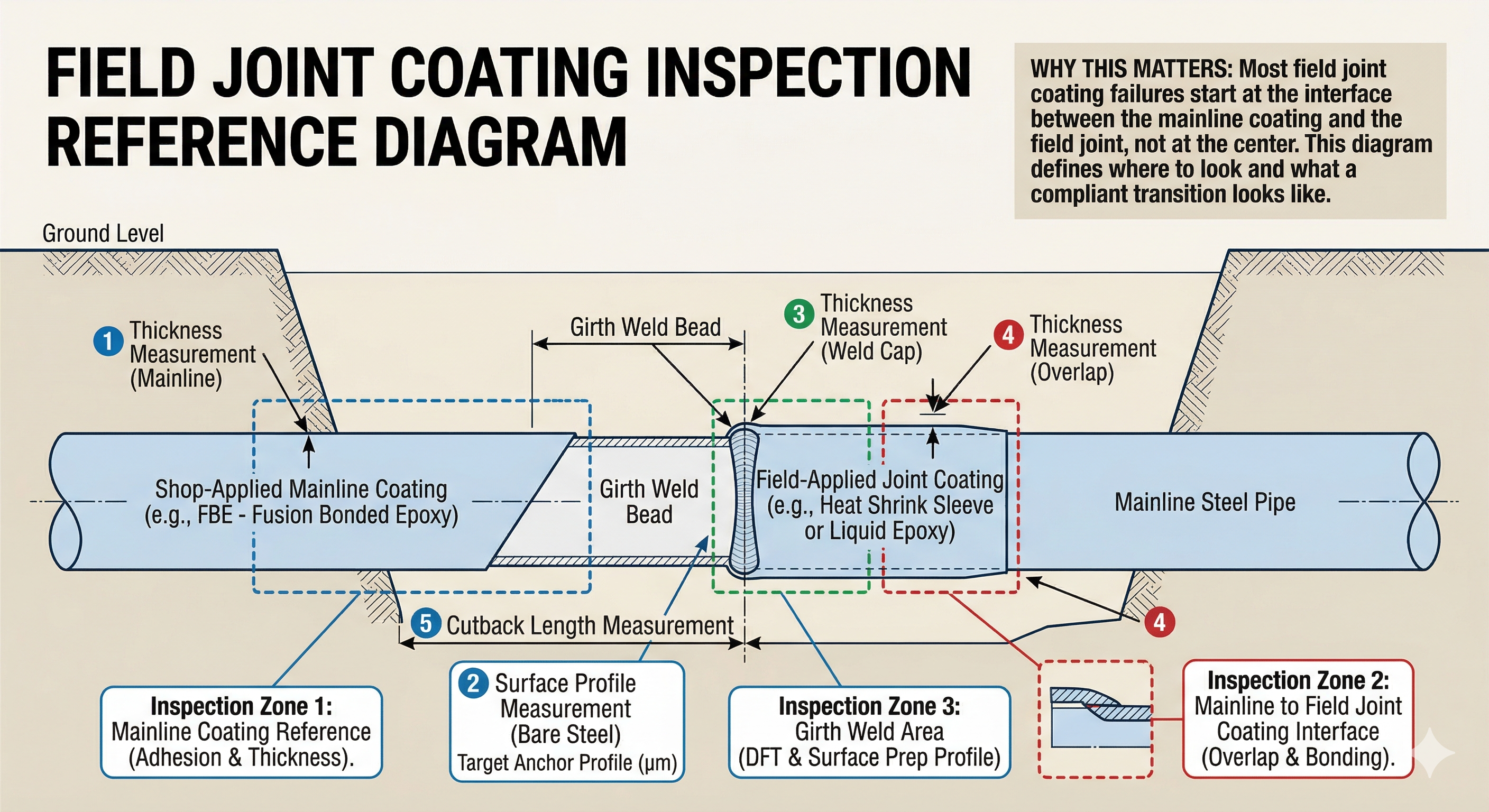
Field Joint Coating Inspection Reference Diagram
A technical diagram of the field joint inspection zones, measurement point locations, and coating transition details. Shows the relationship between the mainline coating cutback and the field-applied joint system.
AMPP Coating Inspector Program (CIP)
The primary professional certification for coating inspection, administered by AMPP (formerly NACE International). Includes Level 1, Level 2, and Peer Review designations.
Pipeline Coating Inspection FAQ
What does a third-party pipeline coating inspection cover?
Surface preparation verification (cleanliness, anchor profile, soluble salt testing), application monitoring (temperature, mixing, induction times), 100% holiday detection, dry film thickness verification, field joint coating inspection, and cure confirmation — with every hold point documented against the joint number.
Do you inspect FBE coating specifically?
Yes. FBE coating inspection at the plant, yard, or field joint is a core service — including pyrometry verification, Bresle salt testing, holiday detection per NACE SP0490, and cure verification against CSA Z245.20. Our inspectors have applied FBE themselves, not just inspected it.
Where do you provide coating inspection services?
Nationwide across the United States and Canada. We are based in Houston, Texas and deploy to coating plants, pipe yards, and pipeline rights-of-way wherever the project is.
What credentials do your coating inspectors hold?
NACE/AMPP Coating Inspector Program (CIP) certifications, backed by direct pipeline coating application experience and active participation in the NACE, AMPP, and ISO committees that write the standards.
Need inspection for an upcoming project?
Tell us the project timeline, coating systems involved, and what the current inspection plan looks like. We fit around your schedule.
Contact Us